Case Study · Bibliographic & Rare-Source Intelligence
Rare-Source & Bibliographic Intelligence
Tracing ghost citations, unstable serializations and conflicting literary records.
Some literary research problems begin where conventional bibliography becomes uncertain. A work may survive only through a secondary citation. A newspaper serialization may be incompletely traced. Variant titles, pseudonyms, conflicting dates and later republications can make an apparently simple bibliographic identity difficult to establish.
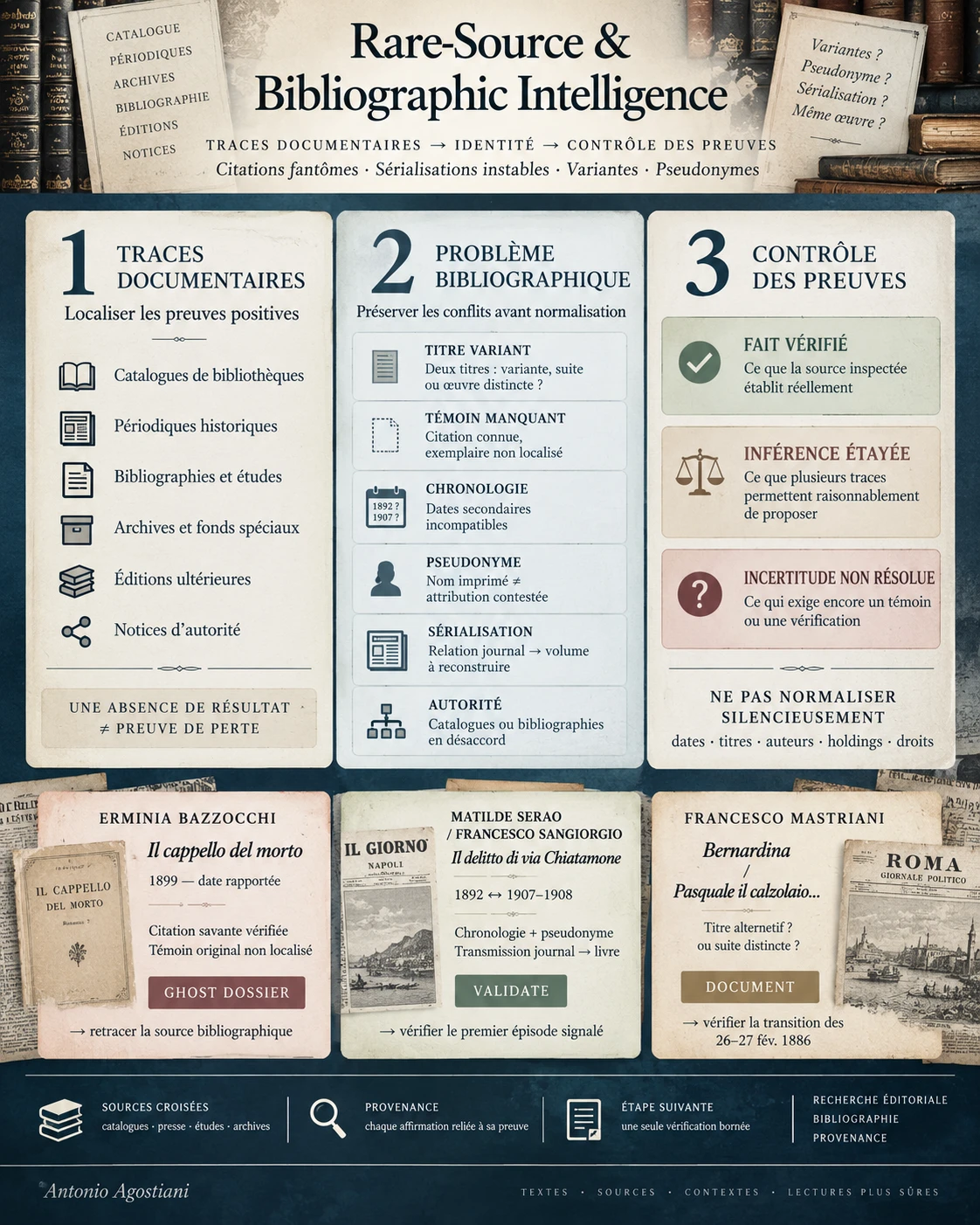
The Research Problem
Rare, forgotten and weakly catalogued texts often leave fragmented traces across library catalogues, scholarly studies, historical periodicals, archive descriptions and later editions.
The difficulty is not simply finding more references.
It is determining what each reference actually establishes, how different witnesses relate to one another, and which conclusions remain unsupported.
The research therefore separates verified evidence from supported inference and unresolved uncertainty, while keeping rights, access and bibliographic identity as distinct questions.
A Controlled Bibliographic Workflow
Trace documentary evidence
Search across catalogues, digitized periodicals, scholarly references, archive descriptions, authority records and later editions to identify positive documentary traces.
Normalize identities and relationships
Preserve variant titles, pseudonyms, dates, serial and book forms, edition relationships and conflicting authority data without silently collapsing them into a single record.
Evaluate the evidence
Separate what the inspected evidence verifies from what it reasonably suggests and what still requires a primary witness or further research.
Assign a research disposition
A case may be marked VALIDATE, DOCUMENT, GHOST DOSSIER or CONTEXT according to the strength and nature of the surviving evidence.
Define one next verification step
Instead of treating an unresolved dossier as complete, the investigation ends with one bounded action capable of materially improving the evidence.
Evidence Examples
Erminia Bazzocchi — Il cappello del morto
GHOST DOSSIER
A 2003 scholarly study cites Il cappello del morto by Erminia Bazzocchi and dates it to 1899.
The research verified the existence of that scholarly assertion, but did not establish an original edition, serialization, contemporary advertisement, publisher record or inspectable copy.
The correct research object is therefore the provenance of the citation — not a presumed lost novel.
Next evidence: trace the bibliographic source behind the 2003 citation.
Matilde Serao / Francesco Sangiorgio — Il delitto di via Chiatamone
VALIDATE
Secondary sources disagree over the early chronology of the work.
One source gives 1892; later research reports a 1907 serialization in Il Giorno under the name Francesco Sangiorgio, followed by a 1908 volume and the 1916 Salani edition Temi il leone!.
Later stages of the transmission are bibliographically traceable, but the opening serial witness has not yet been inspected. The problem is therefore chronology, pseudonymous presentation and serial-to-book transmission — not rediscovery of an unknown Serao novel.
Next evidence: inspect the opening reported 1907 Il Giorno installment with date, masthead and printed byline.
Francesco Mastriani — Bernardina / Pasquale il calzolaio del Borgo Sant’Antonio Abate
DOCUMENT
Bibliographic descriptions conflict over the relationship between the two titles.
Individual records report successive serializations in the Naples newspaper Roma, while another bibliography presents Bernardina as an alternative title for Pasquale.
The available evidence instead favors two distinct works in a sequel relationship.
The value of the investigation is therefore bibliographic clarification and prevention of a false work-level merge, rather than discovery of an unknown text.
Next evidence: collate the closing and opening Roma feuilleton leaves of 26–27 February 1886.
What the Method Is Designed to Prevent
- treating absence from one catalogue as proof that a work is lost;
- treating a secondary citation as proof of a physical edition;
- silently resolving conflicting dates or title variants;
- merging related works before their relationship is established;
- interpreting a pseudonym as disputed authorship without evidence;
- confusing public-domain status with actual digital access;
- treating an inaccessible source as a nonexistent source;
- presenting unresolved investigation as completed discovery.
Transferable Editorial Value
The same method can support research on:
- forgotten authors and neglected literary corpora;
- historical newspaper serializations;
- edition and translation histories;
- variant titles and pseudonymous publication;
- ghost citations and weakly catalogued works;
- metadata normalization and authority reconciliation;
- archive-led editorial projects;
- preliminary source dossiers before deeper editorial investment.
The objective is not to automate scholarly judgement, but to make complex bibliographic evidence more structured, traceable and reviewable.
Research Note
These examples document ongoing bibliographic investigations. A GHOST DOSSIER records a positive documentary trace whose underlying publication or witness still requires verification. It does not mean that a work has been proven lost, suppressed or previously unknown.
Rights status and access status are evaluated separately. Public-domain status of an underlying text does not automatically authorize reuse of modern editions, scans, photographs or institutional images.
What this case demonstrates
Rare-source investigation, bibliographic evidence control, serialization research, variant-title analysis, pseudonym tracking, provenance management and the ability to turn unstable documentary traces into structured editorial knowledge without overstating the evidence.
Discuss a rare-source or bibliographic research project →